“Meehan employs vibrant and forceful language skilfully to challenge the often-oppressive forces identified in her poetry”. (2023)
Feedback: Great essay – mostly because it clearly aims to address precisely what is being asked. The structure is theme by theme, which isn’t easy to pull off and frankly, for most people, I would recommend poem by poem as it usually flows better. The author spoke very well about the role of women – something many students can’t seem to manage as they slip into talking about the political issue itself rather than as it relates to the poetry. The author is a little hesitant and occasionally repetitive, but this is enhanced with practice. Low H1.
You may also like Complete Guide: H1 Leaving Cert English
“Keep your face to the sunshine and you cannot see the shadow.” This is a quote I believe perfectly encapsulates Paula Meehan’s poetry. I would have to concur that throughout her work, she does use carefully crafted language and techniques to brighten up the often-oppressive forces of poverty, drug use, etc. (I wouldn’t use etc in an introduction – make a list of three, it’s implicit that it’s not an exhaustive list. This author overuses it, as a filler word.) I find her work to be compelling, as even with the darkest of topics Meehan is able to find the light. I will be proving her use of forceful and vibrant language, and how she changes the narrative of oppressive forces that were prominent in her life. The oppressive forces I shall be focusing on are poverty, loss, and the role of women.
I find that poverty is the most prominent oppressive force within Meehan’s childhood and adolescence. She talks about never-ending struggles between paycheques, and how this has torn apart her family. Poverty is an important aspect as it allows me to show how Meehan enlightens this dark topic with her charismatic language. The poem that best deals with this is “Hearth Lesson.” It enables me to dive into this specific theme from an interesting perspective.
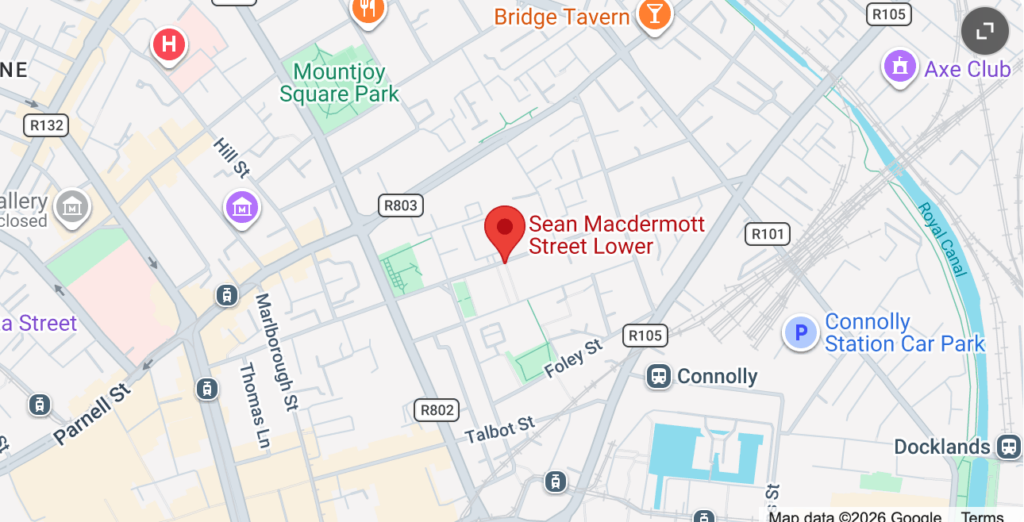
“Hearth Lesson” is an analepsis of Meehan’s parents fighting whilst living in a flat on Sean MacDermott Street. She opens the poem with a cheerful quote, “Money to burn, burning a hole in your pocket.” I find Meehan begins with this to playfully joke about the fact that they are plagued with poverty. She uses irony to allude to the fact that they have too much money to spend and secondly, that they are eager to spend it. I contend that Meehan’s use of humour allows her to approach the dark theme of poverty without overwhelming the reader. She later describes the wages that were essential as “trapped exotic birds” whose “flames were blue and pink and green.” The use of these vibrant colours distracts us from the harsh reality of her family’s financial difficulties. It is notable that Meehan tries to use an uplifting tone rather than a dull, depressive one to convey the forces of poverty. This contrasts with another one of her poems, “The Pattern,” where Meehan challenges poverty and regret with a critical voice.
Loss is an undeniable force often mentioned in Meehan’s poems. In the two poems I have chosen to dissect we can see the skilful language combating this natural, but dark topic. Firstly, “The Prayer for the Children of Longing.” This poem illustrates the effects of the heroin epidemic on the area Meehan grew up in. Every other day a young soul would be lost, signified by a “knock on the door” from Gardaí, etc. Meehan uses this oppressive force through careful language to give hope to the families affected by it. She tells us how the young souls will live on in “wind through the branches,” “song of the river,” and “holiest prayers.” This hopeful language puts light to the darkness, shows how they will not be forgotten, and that they did not deserve to die. I believe that the “holiest prayers” represent how they shall give hope that their sacrifices will eventually bring light at the end of the tunnel and a stop to this plague. The poem is set in the “heart of winter” “at the heart of the city.” My understanding is that the poet’s use of the language “winter” signifies that their struggle will end as Spring is just around the corner. Ultimately, this poem uses vivid language listed above to oppress highlight (?) this unjust loss.
Loss is also prevalent in the poem “Death of a Field.” In these two poems the type of loss is quite different. “The Prayer for the Children of Longing” is about the death of children, while “Death of a Field” explores the loss of memories and nature. We see the effects of urban sprawl in Finglas where Meehan grew up. She discusses the memories within the field she had that are now being torn apart, “Where first smokes, first tokes, first gropes were had.” Meehan enlightens the sense of loss by looking back at all the happy memories she had there, all her firsts. This signifies the deep connection with the field, linking it with vivid imagery of beautiful plants: “dandelion, dock, teasel, primrose,” etc. From these poems it is evident that loss is an oppressive force prominent in Meehan’s life. They cover different types of loss, while still using language related to nature e.g. a “great tree from the far northern forest” as well as vegetation such as “thistle, sloe, herb, and eyebright.” Conclusively, I feel Meehan’s use of language is a major factor portraying loss.
Moving on, the role of women is mentioned repeatedly in the work of Paula Meehan. I can clearly see that Meehan is very passionate about this topic. The two poems I have chosen to deconstruct are “Buying Winkles” and “The Statue of the Virgin at Granard Speaks.” These two poems are thematically related but very different in the aspect of language. Firstly, in the first stanza of “Buying Winkles” we are met with women left at home or forced to do unholy work. Meehan portrays the language in this poem as a child oblivious to the oppressive force of the dark, unsafe streets of Dublin at night, “Even in the rain I was happy” , “I’d wave up to women at sills or those lingering in doorways.” This shows us the dark struggle of women in this era. However, Meehan makes the point feel light-hearted and innocent as she “waved” to them and “weaved a glad path through men heading out for the night.” This allows Meehan to confront the issue of the unfair role of women. The poem shows us women trapped at home communicating through windows, while subtly implying that some are engaging in prostitution. Overall, we see Meehan get her point across while engaging in her vibrant childlike character.
I found “The Statue of the Virgin at Granard Speaks” to contain one main theme where Meehan uses her poetry to meaningfully challenge a problem deeply rooted in Irish culture. My understanding of this poem is that the main theme is the role of women. I feel the tone of the language has majorly shifted from the cheerful Meehan we know and recognise. She uses her forceful language to engage listeners, “And though she cried out to me in extremis I did not move.” We see this dark imagery of a girl begging for her life to a statue. For me, Meehan chooses this language to show the anguish sustained by “the child who came with fifteen summers to her name” which could have been easily prevented. Yet as a result of the marginalisation of women in the eighties, she was so terrified she kept a “secret” about her so-called “little scandal.” Between these two poems, Meehan targets her oppressive forces from two different angles. One is light-hearted and innocent. Meanwhile the other tries to make a point and go against her normal, satire way of targeting issues, using dark and hateful language to target the Catholic community.
Throughout her poetry, Meehan does try to keep her face towards the sunlight as she tackles oppressive forces in her vibrant ways. Today, I feel I’ve proved this through the poems I have discussed. However, in the last poem “The Statue of the Virgin at Granard Speaks” I find Meehan goes out of her typical way of dealing with controversies. She hits the force head on and does not conceal her language. Overall, it is evident that Paula Meehan does use her vibrant and forceful language to challenge the oppressive forces within her poetry.
Make it count for points.
See the full guide